This guide is for anyone choosing or renewing a retainer, whether or not you’re a developer.
Maintenance, support retainer or managed hosting?
The three terms often overlap in proposals. They don’t mean the same thing.
| Term | What it covers |
|---|---|
| Maintenance | Updates, backups and fixes to keep the site in working order |
| Support retainer | Maintenance plus the small changes your team asks for, with response times written into an SLA |
| Managed hosting | The server, the operating system and server-level security |
A Drupal retainer looks after the code and the modules. If the server goes down, the host brings it back up. The retainer provider then checks that the site is running properly.
What does a Drupal retainer include?
- Security updates Core and contributed modules, applied as soon as a fix affects your site. This is the main reason to have a retainer.
- Minor updates Drupal ships a minor release every six months, in June and December. Starting in 2027, each one gets security fixes for eight months (twelve for the last minor release of a major version), so a site has about two months to move to the next one.
- Tested backups A full backup is restored regularly to prove it actually works.
- Monitoring Uptime is monitored around the clock. Alerts reach the provider first. The response time follows your plan.
- Fixes and improvements A new field, a form tweak, a bug. Covered by the included hours, quoted separately beyond them.
- Report What was done, which versions were installed and what to watch.
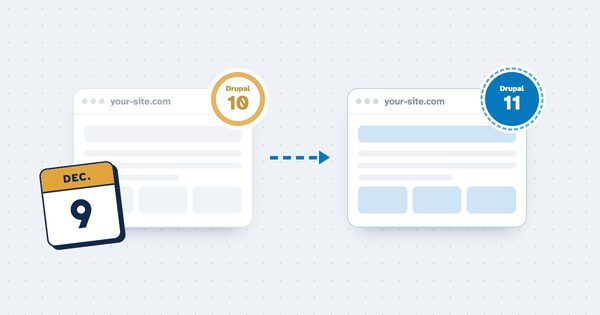
Drupal 10 reaches end of life on December 9, 2026. After that date it gets no security fixes. A Drupal 10 site under retainer should already have its move to Drupal 11 planned.
The path of a security fix
The Drupal Security Team publishes its advisories on Wednesdays. For core, it is usually the third Wednesday of the month. When a core vulnerability is serious, the team can post a public service announcement a day or two ahead with the release date, so you can be ready. A highly critical fix can also come out outside the usual window. Once an advisory is out, the vulnerability is public, including to attackers scanning for unpatched sites. Here is what happens next under a retainer.
- Advisory Usually on a Wednesday, with a risk rating from “Not critical” to “Highly critical”.
- Triage The provider checks whether your site uses the affected module.
- Testing The update is applied in staging and tested.
- Deployment To production, within the time set in the contract, with a rollback plan ready.
On a well-maintained site, this takes an hour or two. On a site that has fallen behind, a single fix can force several overdue updates at once.
Why does a Drupal retainer need a specialist?
A WordPress care plan doesn’t translate to Drupal. A Drupal site is maintained with its own tools and workflow.
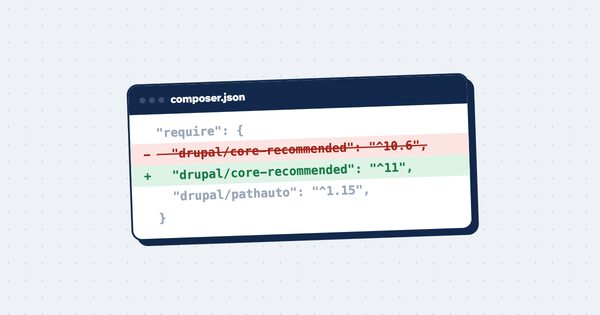
- Composer Core and modules are installed and updated with Composer, not by uploading files through the admin interface.
- Configuration The site settings are exported to files and tracked in Git. A careless deployment can overwrite settings changed on the live site.
- Module patches Many sites run patches from drupal.org issues that haven’t been committed yet. Each one must be tracked and dropped once the fix ships in the module.
- Unsupported modules Only stable releases of modules covered by the Security Team get advisories. A module that is no longer maintained also blocks a major upgrade. It must be spotted early and its replacement planned.
What should the contract and SLA say?
Compare retainers on the numbers written into the contract, not on a list of services.
| Commitment | What to check |
|---|---|
| Severity levels | How a critical outage is defined versus a minor issue |
| Response time | Time to a first written reply, by severity |
| Security patch window | Time from advisory to production deployment |
| Included hours | Hours per month and the billing increment |
| Unused hours | Forfeited or rolled over to the next month |
| Coverage hours | The days, hours and time zone when response times apply |
| Restore tests | How often per year |
| Major upgrade | Included or quoted separately |
| Term and cancellation | Minimum term and notice period to cancel |
A response is not a resolution. Replying within four hours doesn’t mean solving the problem within four hours. A good SLA states both targets, or says clearly that it only commits to response time.
Monthly plan, block of hours or time and materials?
| Model | How it works |
|---|---|
| Monthly plan | A fixed monthly fee covering security work and included hours |
| Block of hours | Prepaid hours used as requests come in |
| Time and materials | Work is billed hourly as it’s done |
A monthly plan guarantees that security updates get applied even in months with no requests. A block of hours suits sites that change in bursts. Time and materials alone is risky. Nobody is responsible for watching the security advisories.
What is usually not included?
- Hosting and outages caused by the host.
- New features beyond the included hours.
- The upgrade to a new major version, such as Drupal 12, except in top-tier plans.
- Fixing changes made by someone else, such as another agency or an in-house developer.
- Content writing and entry, which stay with your team.
None of this is unusual. The problem is a contract that doesn’t spell it out.
How do you take over a site built by another agency?
It all starts with a takeover audit. The new provider reviews the code, the modules and their versions, any hacks made directly to contributed modules, the PHP version and the hosting. You then get a list of what must be fixed before they commit to response times.
They need three kinds of access.
- The code repository Ideally owned by your organization, not the previous agency. Repository ownership is the most common blocker in a handover.
- A staging environment Or the means to create one, so nothing is ever changed directly in production.
- The hosting For backups, error logs and the PHP version.
Can an agency outsource Drupal maintenance under its own brand?
Yes. A white-label partner works in your repository, under your NDA and your processes. They deliver pull requests, report to you and your clients stay yours. I work this way with agencies, for example on the development and maintenance of about fifteen sites for an agency in Montreal.
Is your retainer doing the job?
Five checks you can run without being a developer.
- The Drupal version The Status report page (Reports, then Status report) shows it. Compare it with the latest release.
- Pending updates The Available updates page (Reports, then Available updates) should show no red lines. If the page doesn’t exist, ask your provider how they track updates instead.
- The last restore test Ask for the date and the write-up.
- The code repository Ask where it is and who owns it.
- The last report If there has never been one, that tells you something.
The free Drupal check detects your site’s major Drupal version from the outside, and the exact version when it is visible, without admin access.
How much time should you plan each month?
It depends on how the site is used more than on its size. Here are rough monthly figures, on top of routine updates.
- 30 minutes A small site that rarely changes.
- A few hours A site with active editors and regular requests.
- About a day A site with integrations, a members-only area or payments.
Falling behind costs more than keeping up. A site left two years without updates often takes more work to bring back up to date than a full year of maintenance.
See my maintenance plans Check my site’s version
Sources. Drupal security advisories are published on drupal.org/security. The release schedule is on drupal.org. The eight-month coverage of minor releases was announced in PSA-2026-11-02.